Efficient, but stuck in the past: the corporate AI paradox
We are entering the peak of the creative destruction Schumpeter described a century ago. Entry barriers are falling in sectors that seemed inviolable, software is becoming an infinitely replicable commodity, and small teams now coordinate fleets of agents that work 24/7 without rest. It's a strategic reset in simultaneous layers, and no one can rely on the old rules of competition anymore.
In this context, founders are choosing where to bet and leaders of incumbent companies are deciding what to prioritize on the AI roadmap. Almost everyone is looking at the same landscape, but through different lenses. And that's where a problem appears: rational short-term incentives are pushing capital toward a place that may not be where the next market leaders will be born.
The three types of AI bets, according to Heller
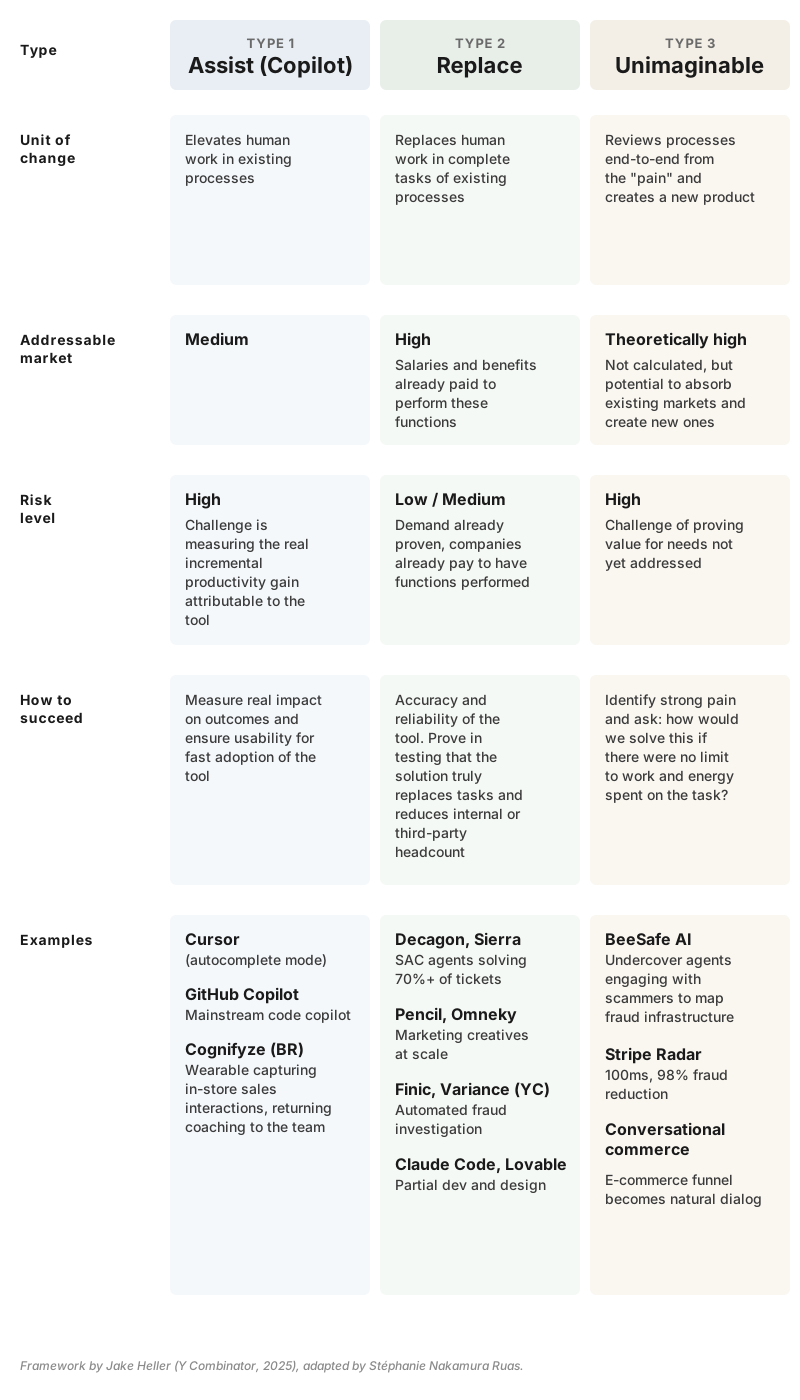
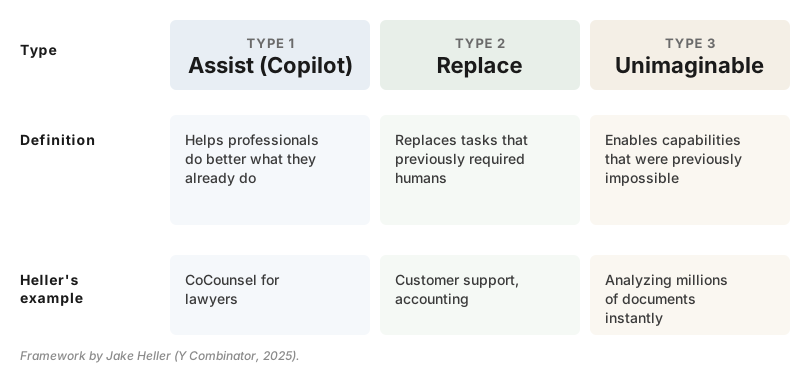
Jake Heller, founder of Casetext (sold to Thomson Reuters for $650 million), gave a talk at Y Combinator's AI Startup School in June 2025 that organizes the landscape into three categories. The framework was designed for founders to choose which wave to surf, but it works equally well for incumbents deciding where to allocate transformation budget.
Basically, entrepreneurs who want to build an AI startup have 3 types of companies they can create:
(1) Assist (Copilot) is AI that helps professionals do better what they already do.
(2) Replace is AI that fully replaces tasks that previously required humans.
(3) Unimaginable is AI that enables capabilities that were previously impossible.
Complementing the framework
Andrew Ng made an adjacent argument at the World Economic Forum in Davos, January 2026: real returns come from top-down workflow redesign, not from bottom-up experiments of incremental productivity. Mapping this, I take the liberty to add to Heller's framework an additional criterion that differentiates the three types: the unit of change.
(1) Assist optimizes tasks within the existing process.
(2) Replace substitutes humans in performing tasks within the existing process.
(3) Unimaginable redesigns the process.
Worth also mentioning that these categories are not airtight compartments. It is very common to start as Assist and evolve to Replace. CoCounsel started as a legal assistant and by 2025 already executes complete workflows. Cursor started as autocomplete and by 2026 orchestrates agents that execute multi-file tasks. The Assist → Replace movement is a trend, not an exception.
Why capital goes to Replace, and why this can be myopia
Rational incentives are aligned to direct capital primarily toward Replace. It's not a coincidence. It's where the risk is lower and the return is tangible. It's viable to substitute part of the tasks of a role, evals ensure accuracy, and the addressable market already exists: you know how much it costs to maintain a team of one hundred analysts, you know that if an agent does the work of ten, ROI is calculable before the pilot. Proven demand, clear metric.
Assist has a different challenge: proving incremental return attributable to the tool can be difficult. ROI calculation requires careful measurement that few companies have. Without that proof, renewing contracts becomes an act of faith.
And Unimaginable faces the opposite: potentially high return, but in markets that may not yet exist. More uncertainty in return, higher execution risk. No adoption benchmark, no comparable case, no regulatory framework. In an environment of expensive capital, this is where investment committees freeze.
In a context of high interest rates globally, with a tight geopolitical scenario between wars, tariffs, and oil price swings, companies prioritize cost reduction and targeted investment. Replace fits exactly into that mandate.
But Ng brought a counterpoint. When a bank uses AI to review a loan, the Replace version is cutting review time from 60 minutes to 10, saving man-hours. The customer still waits days for the final email. The Unimaginable version is different. If the process takes milliseconds, the bank redesigns the entire workflow: marketing, application, risk assessment, and fund transfer become an autonomous loop. The result is a new product, not savings: instant loan. The first company is a bank with lower overhead. The second is the fintech that puts the first one out of business.
Ng's point is dry: stop using AI to pave the old cow paths. Use AI to build new highways. Focusing only on efficiency may leave you efficient, but in the past. For incumbents, it's existential risk. For entrepreneurs, it's an opportunity to create enormous new business.
This is the paradox that titles this essay. Following rational short-term incentives takes you out of the long term. The three-types framework serves three different readers, and each needs to ask a distinct question. Founder: which wave to surf? Replace has a predictable market but a short window before becoming a commodity. Unimaginable has higher risk and real defensibility. Investor: where to allocate among the three quadrants? Diversifying is smarter than concentrating everything in the quadrant with the most visible ROI, because the next leader will be born in the less obvious one. Incumbent executive: how to balance the roadmap? If 100% of the company's AI investment is in Replace, the portfolio defends current position, not captures the next.
How the path to success varies by category
Reliability is a prerequisite in any quadrant. Without rigorous evals, without explicit criteria for what is "great" for each micro-task, without holdout sets to avoid overfitting, no AI product moves beyond the beautiful demo stage. This process is arduous, and where most founders give up. When accuracy is at 60-70%, it's tempting to declare victory. But it's between 70% and 99% where the difference lives between viral demo and sustainable product. This applies especially in sensitive domains like law, health, and financial services, where product error destroys trust that takes years to rebuild.
Heller's method (starting with a dozen evals per prompt, iterating until the AI gets almost everything right, adding fifty more to stress edge cases) applies equally to any of the three types. But the dominant challenge above this foundation changes by category.
In Assist: prove value and ensure adoption
The dominant risk is adoption and measurement. The tool works, AI suggests, human accepts. The challenge is proving that the gain is real, incremental, and attributable to the tool, and not to other variables. Without that proof, renewal stalls. And even with proof, if the usability doesn't make the professional adopt it in the natural workflow, it gets forgotten.
In Replace: technical accuracy at scale
The dominant risk is technical and operational. If you replace ten analysts, the output needs to have the accuracy they would have. Here the evals method matters in its sharpest form: each edge case not discovered in operation is a lost customer or a triggered regulation. The accuracy and scale of usage amplifies both gain and risk.
In Unimaginable: redesign from zero constraint
The dominant risk is another: inventing what hasn't been invented yet. The starting point is the customer's pain, not technology. The question Heller proposes is the key: how would we solve this problem if there were no limit to work and energy spent on a task? Assuming zero constraint (processing cost, human time, latency), what is the real pain that nobody is addressing? Stripe Radar was born from this question. BeeSafe AI too. Redesigning the process from this question is what differentiates Unimaginable from well-done Replace. Building Unimaginable is technically difficult exactly because of this. But it's that difficulty that creates the moat.
The short cycle and the long cycle
Schumpeter's thesis on creative destruction was never about nostalgia. It was about the fact that mature markets are knocked down not by those who optimize the existing product, but by those who create the next category. AI is the most powerful tooling this logic has ever had. Capital will go to Replace for rational short-term reasons, and Replace will indeed generate a lot of value this decade. But the next market leaders will be born in Unimaginable.
Whoever only does efficiency with AI may be doing the wrong game very well.