What is hot in growth marketing with artificial intelligence
I returned to growth and performance marketing after seven years working on other strategic and data-focused layers. The first surprise was that some of the evolutions I started in 2019 still haven't been reached by most companies, especially in measurement and attribution. The second was that other things that seemed fundamental, like bid optimization, got platformized and demand far fewer resources today. The third was realizing we're in a phase of major transformation, similar to the period I lived through working in performance marketing.
This essay is my read on the hot topics for growth today and what has changed in the work and the skills of those operating this function.
Search fragmented away from Google toward GEO and Retail Media
Google used to dominate search and also held the largest display inventory. Today search is increasingly fragmented. Beyond searches on Gen AI platforms (ChatGPT, Gemini, Claude, Meta Search) that I discussed in the essay "How to prepare your brand and products to be recommended by AI", search is also growing directly inside the major marketplaces and ecommerces that have consolidated as destinations.
As marketplaces gain relevance and concentration, retail media grows as a market share mechanism for sellers and a margin lever for the marketplaces. It is the most bottom-of-funnel media there is. The Latin American retail media market is expected to double by 2029, reaching US$ 5.4 billion, with Brazil growing 42% per year. At VTEX Day 2026 it was the topic with the largest physical footprint at the event. VTEX, Magalu, Mercado Livre, Shopee, Drogaria SP, Panvel, PicPay. This is not passing hype.
WhatsApp is Brazil's highest-converting channel
The highest-converting channel has no search bar, no product page, no cart, and converts 3x more than any app.
WhatsApp is a phenomenon in Brazil: 97% of Brazilian smartphones have the app installed and the average Brazilian opens it 30 times a day.
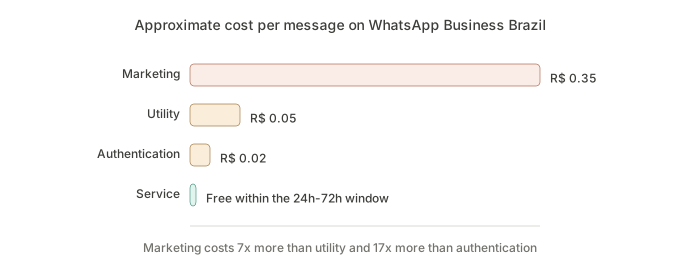
The key question is how to make the math work. To preserve the channel as an intimate space for users, WhatsApp has a cost structure that discourages marketing campaigns. In Brazil, a marketing message costs about R$ 0.35, utility R$ 0.05, authentication R$ 0.02, and service messages initiated by the customer are free within the 24h-72h window.
But with the right strategy, ROI works even for smaller tickets: start with the highest-propensity segments (failed Pix, cart abandonment) and use the return from incremental sales to advance into lower-conversion segments (churn risk). Revi presented an average ROI of 34x using this tactic.
With AI, conversational commerce should reach a meaningful share of retail and services in the future. And it goes well beyond retail. It's already heavily present in services and there's a real opportunity to convert good post-sales experience into recurrence directly in the channel. That's Magalu's bet with Lu.
Performance and growth agencies already have AI in production
At VTEX Day I talked with leaders of reference agencies in growth and performance: Monks, Cadastra, Wicomm. All of them built proprietary AI agents chaining complete workflows: market insights, creative production, asset variation, review, campaign launch.
The work that moves the needle now is positioning, channel strategy, incrementality planning. The agency that understood this sells more strategy and less execution. The one that didn't is competing on price against automation, and that fight has only one possible ending.
Platforms integrated CRM, CDP, messaging and sales with great UX
There are more alternatives to Salesforce now, which is robust but complex to operate. Dito CRM is a Brazilian alternative. I was one of their first corporate clients in 2019. Today they integrate omnichannel CDP, campaigns, sales analytics, cashback, and they shared a feature still in the oven that automatically proposes the right segmentation, message, creative and cadence when there is excess inventory of a specific product. The human only needs to review.
CRM remains one of the company's main sources of first-party data and one of its biggest weapons for understanding customers in depth. It's from that understanding that the next growth frontiers are designed. Complementary segments to expand the base, upsell opportunities, customized offers for higher-value profiles, calibrated reactivation. Treating CRM only as a message-sending tool means using a fraction of its potential.
Measurement is still trying to move from last-click to incrementality
At the last Ecommerce Brasil congress, I attended a talk by DP6 on how to balance top and bottom of funnel to maximize ROI. The methods are practically the same we were pursuing almost a decade ago, only better: (1) Multi Touch Attribution, (2) Marketing Mix Modelling, (3) Lift Experiments with causality and incrementality. Open source libraries like Robyn and Meridian made MMM accessible to anyone who previously only had last-click.
So I asked myself why so many companies still haven't gotten there, and why this topic remains relevant if the infrastructure has become more accessible. I see three challenges. (1) Data foundation, with systematic collection of everything that impacts sales and integration with martech tools. (2) Skill, with statistics and data science to run and interpret the models. (3) Governance and culture, which requires courage to expose what didn't work and to share ROI across channels.
Culture is by far the hardest. People fear exposing what didn't work or losing budget when ROI starts being shared with other channels. Then come the excuses, and the selective narratives with favorable data only. This problem isn't solved by any tool, it's solved by good corporate skills.
Other things that remain relevant
Paid media is still essential to compose sales. The channels from five years ago remain relevant: search, shopping, social, display and remarketing.
Creators and influencers remain one of the most powerful paths to build brand, awareness and authority.
Creativity, brand essence and authenticity remain central to campaign success. AI accelerates all of this, but does not replace the work of having something true to say and saying it well.
Skills for the growth-with-AI era
Twelve years ago performance migrated from marketers to engineers and quantitative profiles. It was the right game at the time. I myself built tools to optimize bids by day of week, time of day, region, device and keyword, automated ad construction and post-A/B test optimization, when that was a real competitive differentiator.
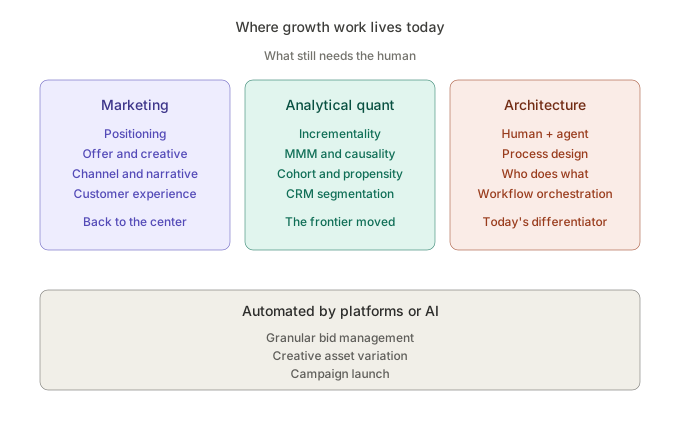
Today's platforms do this better than any in-house tool could. They have more data, more signal, and optimize for ROI with models that internalize context no outsider can replicate. Hyper-granular bid management migrated inside the platforms and is not coming back. It was the biggest skill shift I saw when studying the changes in this area.
This returns growth to marketing territory. Positioning, offer, creative, channel, narrative, complete customer experience. That work came back to the center because the mechanical part has been commoditized.
The quantitative frontier didn't disappear. It moved. Incrementality measurement demands statistical rigor. MMM demands fluency in causality. CRM and CDP segmentation demands reasoning about cohort, lifecycle and propensity. Tools are advancing on this frontier too, and part of the quant work will eventually migrate inside them. But for now this is where real technical differentiation lives, and where those who invest in analytical capacity reap disproportionate advantage.
There is also a third space, one that feels familiar to me. When I structured the performance marketing product at Pareto, in Rio, twelve years ago, I designed and documented all the processes of the operation. We had automation in many points, but it still required humans to run parts of the flow. The work was to architect where machines came in, where people came in, and how the operation flowed without friction. It's a transformation moment with the same nature of the one I lived when digital was blooming. Those who know how to design these processes, now involving agents instead of just scripts and rules, deliver productivity gains.
The takeaway from this re-immersion is that there's a lot of new in growth, but the underlying logic and mechanics remain very similar. The frontiers have expanded. GEO, conversational commerce and retail media opened up large spaces that practically didn't exist five years ago. Incrementality measurement is finally accessible, but requires culture to become practice. Human-agent orchestration doesn't feel that different from the work of structuring as-automated-as-possible digital marketing operations that I did at four companies of different sectors and sizes (Rocket Internet, Pareto, T4F, Assured Labor) between 2012 and 2019, when digital was still settling in.
It's a good moment to re-enter. The new spaces are being designed now, the measurement infrastructure has matured, and the strategic questions feel like the ones from previous turns I've already lived through. There's a lot to build, and this building phase is the one that interests me most.